
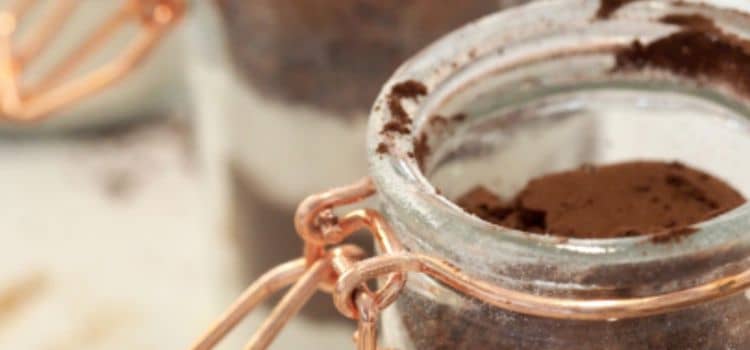
Students are given the results from an investigation into the effect of an anti-caking agentA substance which enables a powder to flow freely. on the flow of cocoa powder. These results can be used to illustrate the modification of powder flow if the investigation in AC1 is not performed.
Document Transcript
UNDERSTANDING YOUR FOOD<br />
the ultimate educational resource<br />
TEACHER NOTES<br />
<br />
teachers’ notes AC2.1<br />
AC2. The function of anti-caking agents - a case study<br />
The effect of Neosyl GP (silicon dioxide, E551) on the ability of<br />
Sainsbury’s cocoa to flow is investigated.<br />
The case study, on pupils sheet AC2, gives the procedures and results for<br />
an example investigation. You may prefer to replace the actual<br />
experiment AC1 with a discussion of AC2.<br />
Neosyl GP (GP = general purpose) is an anti-caking agent. It is capable of<br />
improving the flow of many powders. Sainsbury’s cocoa does not contain a<br />
free- flow agent. Other brands could be used as long as they too<br />
contained only cocoa.<br />
Aim of the first part of the investigation: to determine the orifice size<br />
through which cocoa without Neosyl GP will not readily flow.<br />
Aim of the remaining investigations: to determine the effect on the flow<br />
of cocoa with Neosyl GP added.<br />
KS3 and 4<br />
science<br />
Timing - various<br />
Two pupil activity sheets AC2<br />
accompany this case study.<br />
<br />
THE FUNCTION OF ANTI-CAKING AGENTS - A CASE STUDYpupil activity AC2<br />
Investigation into the effect of Neosyl GP (silicon dioxide, E551) on the ability of<br />
Sainsbury’s cocoa to flow<br />
Method 1<br />
1. Different sized funnels were prepared by removing ‘stems’.<br />
2.100 g of cocoa was placed in the funnels.<br />
3.The sides of the funnels were tapped to allow cocoa to flow through.<br />
4.The number of taps required to remove all the powder was counted.<br />
5.Each test was done 6 times and an average calculated.<br />
Results: Cocoa without Neosyl GP<br />
Orifice size Number of taps<br />
mm 1 2 3 4 5 6 Average<br />
50 4 4 2 2 2 2 3<br />
40 2 1 1 7 3 3 3<br />
30 44202021 2123 25<br />
On the basis of these results, the funnel with the 30 mm orifice was chosen for<br />
subsequent experiments as cocoa would not readily flow through this size.<br />
Method 2<br />
1.100 g of cocoa powder was mixed with varying amounts of Neosyl GP so that the<br />
Neosyl GP was present as 0.1, 0.2, 0.3, 0.4, 0.5, 0.6 % by weight of the final<br />
mixture.<br />
2.The mixing took place in a plastic bag. The two substances were placed in the<br />
bag and shaken vigorously.<br />
3.Each mixture was placed in the funnel, as described before, and the number of<br />
taps needed to get all the powder through the funnel were counted. Each<br />
experiment was repeated 6 times.<br />
4.One of the mixtures, the 0.3 %, was left for ~48 hours before carrying out the test.<br />
5.A 0.6 % mixture was left for ~24 hours before being tested.<br />
Results: Cocoa with Neosyl GP<br />
Neosyl GP Number of taps<br />
% 1 2 3 4 5 6 Average<br />
0.1 23252519 1920 22<br />
0.2 27232016 1719 20<br />
0.3* 7 7 6 6 7 5 6<br />
0.4 6 7 5 3 2 2 4<br />
0.5 5 2 2 4 3 4 3<br />
0.6 7 5 3 2 7 6 5<br />
0.6** 3 2 2 2 2 4 3<br />
* After an interval of ~48 hours<br />
** After an interval of ~24 hours<br />
<br />
pupil activity AC2THE FUNCTION OF ANTI-CAKING AGENTS - A CASE STUDY<br />
Discussion: There appears to be a sudden improvement in flowability between the 0.2<br />
and 0.3 % levels. It is not clear whether this is due to the increase in the level of the<br />
flow aid or to the fact that the mixture was allowed to stand for some time. Leaving<br />
the 0.6 % to stand seems to have improved its flowability. The experiment wasrepeated<br />
starting with the 0.4 % mixture.<br />
Results: Cocoa with Neosyl GP, repeats<br />
Neosyl GP Number of taps<br />
% 1 2 3 4 5 6 Average<br />
0 272739262624 28<br />
0.4 16201412 1510 14.5<br />
0.5 1116 9 1212 8 11<br />
0.6 11 9 7 7 7 6 8<br />
0.7 5 4 3 4 8 4 5<br />
0.7* 1 2 2 1 2 1 1.5<br />
* After ~48 hours<br />
Discussion: These results show some variance with the previous results, some of which<br />
were supposed to be identical repeats. The results indicate that considerably more<br />
than the 0.3% Neosyl GP is needed to achieve good flowability. Leaving the mixtureto<br />
stand for a while is again observed to result in improved flowability.<br />
The experiment was repeated again with larger amounts of Neosyl GP.<br />
Results: Cocoa with more Neosyl GP.<br />
Neosyl GP Number of taps<br />
% 1 2 3 4 5 6 Average<br />
0 351319133122 22<br />
0.7 7 9 9 4 9 3 7<br />
1.0 3 4 2 4 3 2 3<br />
Discussion: It appears from the data that the maximum allowed dose of 1.0% Neosyl<br />
GP will almost make the cocoa entirely free flowing and that leaving the mixture to<br />
stand improves the flow.<br />
The improvement in flow when left to stand may be due to the fact that the Neosyl GP<br />
is capable of absorbing fat. Cocoa has a fat content of ~20 %. The absorption of<br />
fat by the Neosyl GP may thus allow the particles of cocoa to flow more freely.<br />
The action of an anti-caking agent can be demonstrated using ball bearings or<br />
something similar. If particles of the same size are within a container, they reach a<br />
point where they ‘lock’ together and become stationary. The addition of other<br />
spheres ofdifferent sizeshas the effect of ‘unlocking’ the spheres so that they move<br />
again. Cocoa consists of small particles of similar size. The Neosyl GP consists of<br />
particles of a different size to the cocoa. Mixing of the two increases the mobility of<br />
the cocoa particles.
