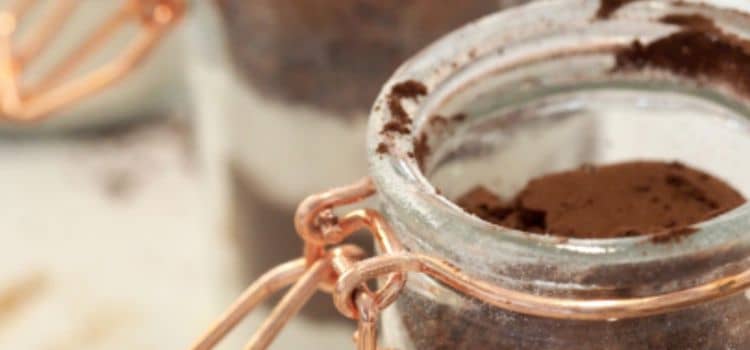
The problem with powders is that the particles tend to clump together. This makes processing difficult and leads to inconsistencies in the texture of foods.
In this lesson, students can design and carry out an investigation to see the effects of an anti-caking agentA substance which enables a powder to flow freely. on the flow of cocoa powder.
Document Transcript
UNDERSTANDING YOUR FOOD<br />
the ultimate educational resource<br />
TEACHER NOTES<br />
<br />
teachers’ notes AC1.1<br />
AC1. The action of an anti-caking agent<br />
Pupils are asked to design and carry out an investigation for a cocoa<br />
manufacturer who wishes to know whether the addition of an anti-caking<br />
agent to the cocoa will help the powder to ?ow more freely through the<br />
machinery. An additional question asks whether leaving the cocoa to<br />
stand further with the anti-caking agent added, a?ects the ?ow.<br />
Hints<br />
It should be noted that, without care, this has the potential to be a very<br />
messy investigation! The cocoa is most easily mixed with the anti-caking<br />
agent by putting the two together into a plastic bag or lidded container<br />
and shaking them. Make sure the bags are tied at the top or that the lids<br />
?t well! When transferring the cocoa from any container into another,<br />
there is a tendency for it to ?y around.<br />
Using either 100 g or 50 g of cocoa (the smaller of the two suggested<br />
funnels will not hold 100 g) it is possible to count the number of taps on<br />
the side of the funnel needed to make the cocoa pass through the funnel.<br />
The process must be repeated a number of times to ?nd a mean.<br />
The maximum amount of anti-caking agent that can be used in food<br />
legally is 1% by mass in the ?nal product. Pupils may design an<br />
experiment which covers a range of concentrations from 0.1 to 1%.<br />
The addition of the anti-caking agent makes a signi?cant di?erence to the<br />
?ow of the cocoa above a certain concentration.<br />
Leaving the mixture to standfor any length of timealso makes a<br />
considerable di?erence. This is one factor which may not be immediately<br />
apparent. Making up all the concentrations together, but leaving them<br />
standing while testing one of them, may a?ect the results. However, it is<br />
advisable to leave the two powders togetherfor a short and standard<br />
period of timebefore carrying out the test. Factors to keep constant<br />
include:<br />
• how ‘strong’ the tap is on the side of the funnel<br />
• how the anti-caking agent and cocoa are mixed before use<br />
• size of funnel<br />
• the length of time the anti-caking agent is left mixed with cocoa<br />
before use.<br />
KS3 and 4<br />
science<br />
Timing - various<br />
Pupil activity sheet AC1 accompanies<br />
this activity.<br />
Requirements<br />
• balance accurate to 0.1 g<br />
• clamps and stands<br />
• powder funnels<br />
[Ordinary ?lter funnels are not<br />
suitable since the opening to the<br />
stem is too narrow; suitable<br />
funnels may be purchased from<br />
Philip Harris, Lynn Lane,<br />
Shenstone, Lich?eld, Sta?s,<br />
WS14 0EE; two sizes are<br />
appropriate and have code<br />
numbers R86432/6 and<br />
R86433/8]<br />
• plastic bags approximately<br />
25x25cm<br />
[It is essential that the bags do<br />
not have holes in them! The<br />
bags are used to mix the cocoa<br />
with the anti- caking agent; you<br />
could also use plastic<br />
containers with lids]<br />
• cocoa<br />
[This must be 100% cocoa and<br />
not have an anti-caking agent<br />
already present (check the<br />
label!)]<br />
•anti-caking agent*<br />
This is suppliedwith the resource.<br />
Store this in a dry place; this<br />
additive is silicon dioxide, E551<br />
• other simple equipment<br />
such as beakers, spatulas,<br />
spoons<br />
<br />
pupil activity AC1TO INVESTIGATE THE ACTION OF AN ANTI-CAKING AGENT<br />
The problem with powders is that the particles in the powder have a tendency tostick<br />
together orcake. This is commonly seen with table salt which sticks in the salt cellar<br />
and refuses to be sprinkled over your chips! This is really only a minor inconvenience<br />
and the problem can often be solved by adding a few grains of rice. It may be<br />
interesting to consider how this works.<br />
Manufacturers of food powders may experience real problems if the powder sticks<br />
together to form big lumps and clogs up the machinery.<br />
Many production systems will use ananti-caking agentat some point in the<br />
production process.<br />
You receive the following letter from the manufacturers of a cocoa powder:<br />
Memo to:Research Director<br />
from: Technical Manager<br />
Chris,<br />
As you know, we manufacture a high quality powdered cocoa which is used in cooking and<br />
for hot drinks.<br />
We have found that particles of cocoa stick together and stop flowing through various parts<br />
of the machinery. This causes us to stop production in order to clear the blockages, which<br />
wastes a lot of time and is costing us a lot of money. The time taken to fill the containers is<br />
double what it should be.<br />
If this situation continues we will be forced to pass this extra expense on to the consumer.<br />
We have available to us an anti-caking agent which claims to help the cocoa powder to<br />
flow more freely and enable us to overcome this problem. We understand, by law,that<br />
the maximum permitted level of anti-caking agent is 1% of the mass of the final food.<br />
We would like you to carry out an investigation using our cocoa and the anti-caking agent<br />
to find out:<br />
a. Does the anti-caking agent really make the cocoa flow more freely?<br />
b. Sometimes the machines are left full of cocoa overnight and so the agent would remain<br />
mixed in with the cocoa. Will this make further difference to how quickly it flows?<br />
Thanks.<br />
You are given the following:<br />
”cocoa<br />
”anti-caking agent<br />
”clamps and stands<br />
”a funnel - if cocoa iscarefully<br />
placed in this funnel, the cocoa will<br />
notflow through the funnel unless<br />
the rim of the funnel is gently tapped<br />
”a balance<br />
”plastic bags or containers with lids in<br />
which you can mix cocoa with the<br />
anti-caking agent<br />
”and other simple apparatus.<br />
Task<br />
Design and carry out an investigation<br />
which will attempt to answer the two<br />
questions asked in the letter.<br />
Hints<br />
”handle the powdersvery carefully;<br />
to avoid mess<br />
”remember to carry out afair test<br />
”remember to write areportfor<br />
the cocoa company.